Monday, March 25, 2013

Eleanor and Park

Let's face it. There are tons of books about love out there. And most of them are terrible. Sure, they might be engaging, and heartwarming, and satisfying, and all that jazz, but almost none of them really tell it how it is. My brother often complains that books like this keep real life nice guys from getting girls, because these girls are too caught up on Edward or Darcy and therefore have unrealistic views about love. Then along comes Eleanor and Park (by Rainbow Rowell). At the outset this book seems like it's going to fall squarely into the category of books mentioned above. It's about a slightly chubby redheaded stepchild (literally) named Eleanor who ends up falling in love with her bus buddy, a half-Korean, semi-popular kid named Park. They bond over comic books and punk rock, and have what I consider to be the best fictional romance I've ever read. And when I say best all I mean is that it felt real. The novel captured all the wonderful things about love: the first hand-hold, the first kiss, the excitement of seeing your crush in unexpected places, the constant longing when they're not around, the need to get as much as possible when you're with them. However, E&P also addresses the less glamorous, and in my experience far more common, elements of romance. The constant doubt, anxiety, and jealousy that come with being in a relationship. Perpetual fretting about whether the person can possibly like you as much as you like them. The frustration of finding that there are still parts of a person's life that they want to keep private. The shame, selfishness, misunderstanding, anger, and worry that inevitably come with being in love. Like being in love, this book was both wonderful and disappointing. The reader develops a bond with the book that is reflective of the bond between E&P. It's good, but it's also a bit punishing. The novel is told from both Eleanor's and Park's perspective, a narrative choice that reveals how every insecurity that one party brings to a relationship is likely echoed by the other. It also demonstrated how wrong we can be about other people and ourselves. Being a guy I sometimes struggled to understand Eleanor's thinking (proving that women are, indeed, crazy), but this novel helped me better understand the mindset that contributed to many of my previous romantic frustrations. Now of course, this is a young adult novel, and so it has the obligatory broken home, domestic violence, verbal abuse, alcoholism, and teen angst. However, these banal elements do not sufficiently compromise the originality or integrity of the novel so as to render it unworthy. This novel perfectly captures what first love is like, but doesn't shy away from the painful truth that first love almost never lasts. It embraces that fact, and explores the intricacies of real love without drowning itself in a sea of sappy metaphors or make-out sessions. I enjoyed it, and I think anyone who can stand a little romantic disillusionment will as well.

Score: 8/10
Read this book if: You need a reminder that love, like life, is never perfect. Also if you're just looking for a little tug at the old heart strings. And possibly if you liked 500 Days of Summer, though that's not a guarantee (there are similarities, but they're also wildly different in tone and content).
Don't read this book if: You don't like reading foul language (cursing abounds, though no graphic content is present), you only go in for happy endings (you shouldn't be reading any young adult lit in that case), or you have no tolerance for a story driven more by characters than by plot.

Thirteen Reasons Why

I'm just gonna come out and say it. I didn't enjoy reading this book. The story was implausible, the writing was choppy, the characters were unrealistic, and it was depressing as all get out. Thirteen Reasons Why, by Jay Asher, tells the story of Clay--a high school kid who mysteriously receives a collection of audio tapes from Hannah, a peer who had committed suicide weeks earlier. The tapes were sent to thirteen people who had a hand in her decision to kill herself. The novel follows Clay through one sleepless night as he listens to the tapes and visits the locations they describe in some sort of twisted scavenger hunt, all the while emotionally berating himself for not having done more to help Hannah. All in all this novel felt like it was trying too hard to fit in with the (typically grim and gritty) genre of young adult literature by tackling head on the most damaging issues youth face. While I certainly appreciate novels that deal with troubling issues, I prefer them to take a slightly more hopeful tack. This novel lacked that redemptive quality, and therefore left me feeling unfulfilled. The conclusion of the novel does offer some sense of closure and optimism, but it can scarcely pull the book out of the morass of self-loathing that comprises its bulk. Yet despite my misgivings I couldn't stop reading it. I stayed up until 4a.m. to finish it. Despite being bleak and miserable, the novel is compelling. Furthermore, I realize that not every story in real life has a happy ending. Sometimes the troubled teen really does choose to end it all. Sometimes young love doesn't pan out. Sometimes we have to live with always wondering "could I have stopped her?" I feel that this novel is addressed more at well-adjusted kids who have friends who may be contemplating suicide, and it does a good job of inviting the reader to think about how our choices effect others both for good and (more frequently, in the case of this novel) for bad. For these reasons I feel this novel does have worth. However, my ultimate qualm with the book isn't its tone, but its lack of originality. Basically if you put Speak and Looking for Alaska in a blender, added just a dash of The Catcher in the Rye, and pressed liquefy, you'd end up with Thirteen Reasons Why. I don't regret having read the book, and I think it's a valuable reminder to us all of the importance of reaching out to others, but if I were to recommend a book to a teenager this would be far from the first thing I'd pull from the shelf.

Score: 6/10
Read this book if: You feel like depressing yourself and wondering about how many people in your life you may have helped drive to an early grave. Also if you need a reminder of why we should be nice to others.
Don't read this book if: You like books that make you happy, or you have access to anything written by John Green, Lois Lowry, J.K. Rowling, or Laurie Halse Anderson. They're better written, and deal with similar issues (okay, maybe not J.K., but her awesomeness overcomes a multitude of shortfalls).

Tuesday, February 19, 2013

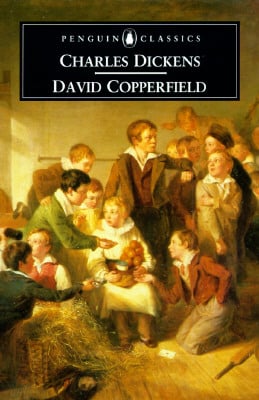
David Copperfield

This is a tough book to review. It's also a fairly tough book to read. The language is typical Dickens: inaccessible and verbose. The plot isn't terribly tough to grasp. As food for discussion and dissection, this book is tops. As a pleasure read, not so great. It's 900 pages long, so there's that. Plus, it's just not that interesting from a plot perspective. It's about a guy who grows up. Sometimes he's poor, sometimes he's not, and it's all about how he gets from rich to poor to rich to poor to rich again. I admit that there's a decent amount of good old Victorian humor, and the characters in the novel are terrific. Mr. Micawber and Aunt Betsey have got to be two of the funniest characters ever written. Overall I am forced to admit that David Copperfield is a really good novel. The writing is great, the characters are wonderful, and the depth of the thing is just unfathomable. However, the real question is "is it fun to read?" The answer is...yes, with a few caveats. It isn't as easy to read or as pleasantly engaging as modern novels, particularly works of Young Adult Fiction. Furthermore, reading DC requires quite a commitment, since it's so long. However, if you have the patience to read a very long novel, and if you enjoy Victorian literature and aren't expecting Harry Potter levels of plot engagement, DC is a very rewarding and worthwhile read.

Rating: 8/10
Read this book if: You need an infusion of British class struggle while you wait around for the next season of Downton Abbey.
Don't read this book if: You can't handle long works of literature, big words, or books that require analysis and discussion to be fully appreciated.

Sunday, January 6, 2013

Dandelion Wine


Ray Bradbury is best known for writing Fahrenheit 451 and other science-fiction novels. It should come as no surprise then that I was completely caught off guard by this simple, beautiful, heartfelt novel about a young boy’s experiences over the course of a single summer. I enjoyed reading this book immensely. Sometimes novels just tell you a story, and sometimes novels invite you into a world where even the most mundane and ordinary things become special. Dandelion Wine is one such book. Although the book doesn’t relate any events that are particularly amazing, the language used to describe the events makes everything seem magical and rare. A trolley ride or a summer afternoon in the woods becomes transmuted before the reader’s eyes into a fleeting moment of pure beauty caught on the page, preserving the very essence of what it is to be a child, and what it is to be alive. This novel reads more like a series of loosely connected short stories than one strongly cohesive narrative, but every story paints a vivid scene as if the words on the page were brushstrokes on canvas.  Much like A Tree Grows in Brooklyn, this book reveals the beauty and wonder to be found in life, pure and simple. If you want a book that enchants you with the beauty of its imagery, the profundity of it’s ideas, and the simple clarity and joy with which the narrative unfolds, you would be well served by picking up Dandelion Wine.

Score: 10/10
Read this book: If you love beautiful language and stunningly vivid imagery, if you want to see the world with the wonder of childhood, or if you want to be reminded what a gift it is to be alive.
Don’t read this book: If you rely on a strong central plotline to maintain interest in a book. Although every story presented is delightful, they can sometimes seem of little relevance to the rest of the book. They do relate, but often only loosely.

Tuesday, January 1, 2013

My Antonia


My Antonia, by Willa Cather, tells the life story of a Bohemian girl named Antonia as told through the eyes of her closest friend Jim Burden. It’s a lovely novel, and worth reading for the strength of the language alone. However, I found the plot itself to lack the level of engagement that makes for a really compelling story. Cather’s descriptions of life on the plains of Nebraska are evocative, and convey the power, beauty, and nobility of the humble life of America’s plainsmen. Once you get past the beauty of the language, however, the story is very simple. I’m sure a good professor could open my eyes to the wonder of this book, and all the deeper meanings the lie within, but just reading it on my own I didn’t get a whole lot out of it besides an appreciation for the simple beauty of everyday life.

Score: 7/10
Read this book: If you like beautiful images of rural life conveyed through eloquent and poetic language.
Don’t read this book: If you prefer a story driven by plot rather than character.

The Catcher in the Rye


I am forced to admit that I think this is a very good book. However, I do not think it is a very enjoyable book. Anyone who has studied literature realizes that, although the two categories often cross over, they certainly don’t have to. The main character of Catcher is a dissolute teenage boy named Holden Caulfield. The novel begins with Holden getting kicked out of his third boarding school in a row because he refused to apply himself in the least degree, and he spends the rest of the novel wandering around New York looking for things to do and people to talk to. It’s rather boring, but also terribly sad. Although many of Holden’s encounters seem unrelated and pointless, they ultimately weave together to present a picture of a young man who is terrified of his future, desperately wants someone who will listen to him, and finds himself without a soul to rely on. The title of the book comes from a poem Holden hears: “If a body catch a body coming through the rye.” When asked what Holden would like to be, he responds that he would like to stand at a cliff at the edge of a rye field and catch children at play if they got too close to the edge. I personally feel that Holden is terrified that he is heading towards a cliff, yet there is nobody in the rye to catch him. The book does not offer easy answers or resolutions to these problems. Holden is part of a larger group of America’s youth who grew despondent in the wake of WWII, and who saw little point to their lives. Many argue that Holden is not a likeable character, and they’re right. There’s this idea going round that main characters in novels should represent the sort of person that we want to be, but Holden represents that sort of person that we secretly already know we are. When I’m honest with myself, I see far more of Holden Caulfield in me than I see of Harry Potter. It’s a revelation that is at once sad and liberating, for it makes me a part of a larger human experience of shared anxiety and doubt. All in all I think this book is worth reading if you want to feel all those human things, and are willing to accept an ending which, like endings in life, can’t be described as satisfying or happy. Catcher is one of the most famous novels of the 20th century, and I believe it deserves to be so for the way it captures so many tragic elements shared by so many in this big thing we call humanity.

Rating: 7/10
Read this book if: You are willing to read deeply, look for metaphor and symbolism, and connect with the sorrow, anxiety, and fear that exist under the surface of every human life.
Don’t read this book if: You are bothered by pervasive mild profanity (Holden is constantly swearing, but they’re pretty soft curse words); or you like books with engaging plots, likeable characters, or happy endings (you won’t find those here).

The Disreputable History of Frankie-Landau Banks


 I thoroughly enjoyed reading this book. It’s light, fun, and the main character is delightful. I found some of it a bit hard to believe, but I don’t think realism is the main point of the book. It was full of teenage hijinks and shenanigans, and was surprisingly clean in a genre that is increasingly graphic and gritty. I wouldn’t hesitate to recommend this book to any reader at any age level if they are looking for a book that is fun, and that also has some interesting points about the nature of society. I particularly like the comparison of society to the Panopticon, a prison that allowed the inmates to be seen without seeing their observers. Society is similar, and therefore people keep in line whether or not they’re being watched. I like the idea of questioning the Panopticon, pushing back against it, and challenging those systems that are governed by sets of rules so old that nobody remembers why the rules came about in the first place. It’s a good book, I liked it, but it’s not something earth shattering or life altering.

Score: 8/10 
Read this book if: You want an entertaining and light read, or you want a story of a young woman finding the courage to question existing social conventions through subterfuge, pranks, and hilarity. 
Don’t read this book if: You have no tolerance for predictable writing or somewhat shallow plot lines and character development. The book is fun, but it certainly lacks the depth of more mature works. Also if you are unwilling to suspend your disbelief regarding certain plot elements. Some of the novel makes one a bit incredulous.